Creating Economic Justice and Fairness
Learn more about our commitment to building thriving communities.
Aboriginal and Torres Strait Islander recognition and justice.
Anglicare WA acknowledges Aboriginal Peoples as the Traditional Custodians of the lands on which our services operate and as holders of the world’s oldest continuing living cultures. We pay our respects to Elders past and present and honour Aboriginal Peoples’ enduring connection to Country, as well as their strength, cultural resilience, and sophisticated knowledge systems.
Anglicare WA has a long history of working closely with Aboriginal Peoples, as clients, advisors and partners in social change. We are proud of our history and of the support we provide to approximately 7,000 Aboriginal Peoples across the State each year. We also recognise that our organisation, just like our community and our country, still has a lot further to go.
.jpg?language=en)
Aboriginal and Torres Strait Islander Peoples continue to demonstrate resilience, leadership, and deep cultural knowledge despite enduring structural barriers shaped by the legacy of colonisation.
Within governments and institutions, these barriers limit equitable participation and constrain opportunities for Aboriginal Peoples for self-determination.
Addressing these systemic barriers presents a significant opportunity to improve social, cultural, and economic outcomes by strengthening inclusive decision-making, embedding cultural intelligence in policy development, and upholding the right to self-determination through genuine partnership with communities.
Note about terminology: We use the term ‘Aboriginal’ to refer to Aboriginal and Torres Strait Islander Peoples.
Note: These statistics may fluctuate based on recent reports released. Sources can be found further down the page.

Life expectancy is 8-9 years lower for Aboriginal Australians than non-Aboriginal Australians¹
Aboriginal people represent 3.8% of the population, yet make up 37% of people incarcerated²

In WA, Aboriginal children are over 20 times more likely to be placed in out-of-home care³

Aboriginal women are 34 times more likely to be hospitalised due to family violence⁴

In 2023, suicide accounted for 5.2% of all deaths among Aboriginal people⁵

Aboriginal unemployment is over 4 times higher than non-Aboriginal unemployment⁶
We’re listening to Aboriginal communities about what works. We’re calling on the Federal and State Government to get behind the following:
.jpg?language=en)
1. Australian Bureau of Statistics. (2023). Aboriginal and Torres Strait Islander life expectancy.
2. Australian Bureau of Statistics. (2025). Prisoners in Australia.
3. Human Rights Watch. (2025). Australia: Disproportionate Removal of Aboriginal Children.
4. Australian Government. (2023). First Nations‑led data research on family, domestic and sexual violence [Media release]. Ministers for the Department of Social Services.
5. Australian Institute of Health and Welfare. (n.d.). Suicide and intentional self-harm hospitalisations among First Nations people.
6. Australian Institute of Health and Welfare. (2025). Employment of First Nations people.
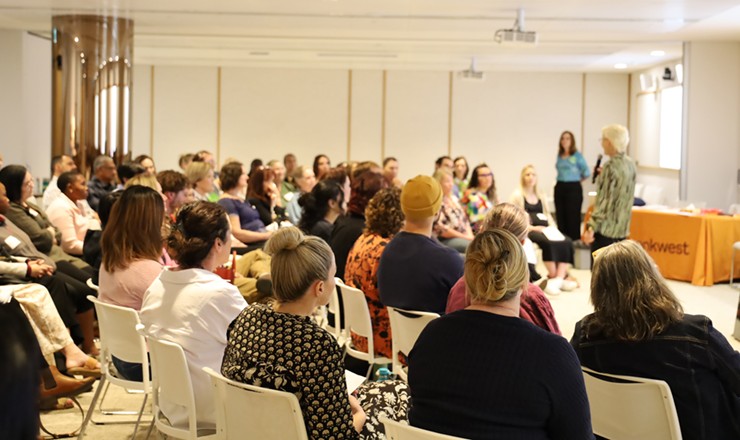
Join us in advocating for a fairer, more just Western Australia.
When you add your voice to ours, we become stronger, louder, and better equipped to drive the systemic change our communities deserve.
Together, we can create a future where everyone can thrive.
Through our advocacy, we are committed to creating economic justice and fairness, ensuring everyone has a home, seeking freedom from family and domestic violence and abuse, and supporting Aboriginal and Torres Strait Islander recognition and justice recognition and justice through the principles of truth-telling, listening, healing, and valuing Culture.

We acknowledge Aboriginal Peoples as the Traditional Custodians of the lands that our services are based on and pay our respects to Elders of these lands both past and present. Anglicare WA delivers services across many Countries in WA, from Balanggarra Country in the North to Minang Noongar Country in the South. In particular, we wish to acknowledge the Custodians of the lands where our offices operate. We would like to thank the Noongar, Miriuwung Gajerrong, Tjurabalan, Yawuru, Nyikina, Ngarluma, Kariyarra, Nyiyaparli, Martu, and Wangkatja peoples for their wisdom and generosity.